As global manufacturing shifts toward hyper-flexible, high-duty production lines, selecting an OEM/ODM robotic arm manufacturer requires evaluating kinematic repeatability, total cost of ownership (TCO), torque density, and system integration interoperability. This engineering whitepaper outlines critical procurement benchmarks, technological developments, and deployment topologies for modern 6-axis industrial and collaborative robots (cobots).
Engineered for MIG/CO2 welding, fiber laser jointing, CNC lathe machine tending, and precision pick-and-place automation. Built with high-torque harmonic reducers and EtherCAT bus control.
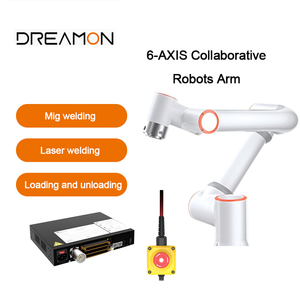
Payload / Reach: 5kg / 922mm
Application: MIG/CO2 Steel Structure Welding
Kinematics: 6-Axis Articulated Cobot
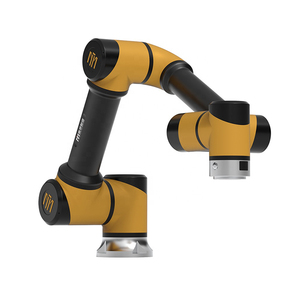
Control Architecture: Integrated EtherCAT Bus
Safety Rating: ISO 13849-1 PLd / ISO/TS 15066
Operation: Direct Drag-to-Teach Mode
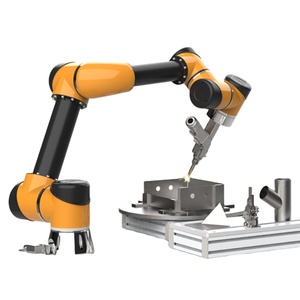
Repeatability: ±0.02mm Precision
Use Case: CNC Lathe Tending & Drilling
Enclosure Rating: IP65 / IP67 Wrist Protection
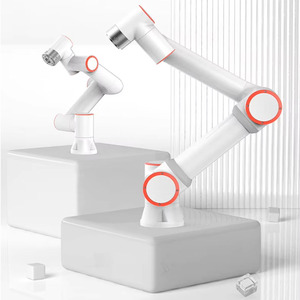
Drive System: High-Torque Servo & PLC Integration
Function: Pick & Place / Welding Assembly
Kinematics: 6 DOF Modular Joints

Programming: No Code / Graphical UI
Payload Capacity: 5kg Nominal
Target Deployment: Rapid Logistics & Packaging
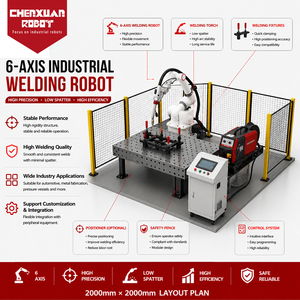
System Package: Integrated Power Source & Torch
Customization: Full OEM/ODM Mechanical Modifications
Application: Heavy Industrial Automation Cell
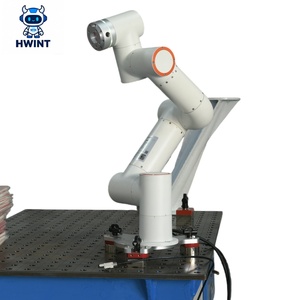
Specialization: Fiber Laser Precise Tracking
Path Speed: High Dynamic Trajectory Smoothness
Axis Configuration: 6-Axis Articulated Kinematics
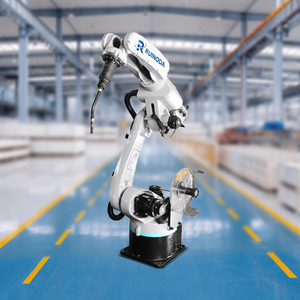
Duty Cycle: 24/7 Heavy Industrial Rating
Functions: Handling, Polishing, High-Load Arc Welding
Structure: High Rigidity Cast Iron & Alloy Payload Arm
Procurement leadership in modern manufacturing has evolved beyond comparing upfront purchase prices. Evaluating China’s top robotic arm manufacturers requires a comprehensive analysis of Total Cost of Ownership (TCO), supply chain transparency, component standardized modularity, and rapid engineering deployment frameworks.
Information Gain Metric: Procurement shifts toward Modular Joint Integration. Sourcing robotic arms with standardized EtherCAT fieldbus communication protocols reduces cell commissioning cycles by up to 60% compared to legacy proprietary hardware interfaces.
Modern 6-axis articulated arms now incorporate low-inertia permanent magnet synchronous motors coupled with regenerative power bus architectures. When braking during deceleration phases, kinetic energy is recycled back into the main control cabinet grid, reducing operating electrical costs by 18-24% over continuous 24/7 production shifts.
Historically, harmonic drives and RV reducers posed supply chain bottlenecks. Leading Chinese manufacturers now manufacture strain-wave gears and cross-roller bearings in-house. This vertical integration guarantees Mean Time Between Failures (MTBF) exceeding 50,000 operational hours while maintaining spare parts availability within 48-72 hours globally.
The global shortage of specialized robotic programmers has accelerated the procurement of cobots featuring force-torque sensing for intuitive drag-to-teach programming. Factory technicians can define complex welding paths or pick-and-place trajectories physically within minutes, drastically lowering technical entry barriers.
The convergence of edge computing, machine vision, multi-axis motion control algorithms, and functional safety standards has reshaped the functional baseline for industrial robot arms.
Advanced 6-axis manipulators employ polynomial jerk-limited trajectory generation algorithms. By calculating continuous acceleration curves in real-time at sub-millisecond loop rates (1kHz to 4kHz), arm micro-vibrations during high-speed stop-and-go cycles are eliminated. This advancement improves spatial accuracy during high-speed arc welding and high-precision fiber laser cutting applications.
Native visual serving integration allows robotic arms to automatically compensate for workpiece positional variance on unsorted conveyor lines. Utilizing deep-learning point cloud algorithms, 3D vision cameras mounted on the arm wrist enable random bin-picking, automated flaw identification, and dynamic seam tracking for MIG and TIG welding without rigid mechanical fixture positioning.
Collaborative arms utilize joint-integrated dual-channel optical encoders and motor current torque feedback sensors. In the event of unintended physical contact with human operators, collision detection mechanisms trigger power and force limiting (PFL) safety stops within milliseconds (<15ms reaction window), eliminating safety fencing requirements in shared work environments.
Modern B2B deployments leverage digital twin simulation tools. System integrators can model cell cycle times, reach dynamics, and singularity avoidance off-line prior to physical installation. Industrial IoT connectivity via OPC UA and MQTT protocols ensures seamless bidirectional telemetry streaming into MES and SCADA central command platforms.
Building high-reliability industrial automation demands strict production discipline. With over 25 years of electrical and mechanical automation history, our engineering plants deliver field-proven robotic systems built for demanding industrial environments.
We operate dedicated surface-mount technology (SMT) lines for drive control boards and precision CNC machining centers for structural robot cast alloys, ensuring complete quality control across all critical sub-assemblies.
Every control cabinet and robotic wrist assembly undergoes rigorous environmental testing, vibration stress testing, and high-voltage insulation validation compliant with IEC 60204-1 electrical standard guidelines.
Overseas customers are supported with comprehensive FAT documentation, laser tracker inspection reports, full load dynamic burn-in tests, and live streaming video verification prior to dispatch.
Our engineering process adheres strictly to global industrial metrics to ensure drop-in operational readiness upon arrival at your manufacturing facility.
EN ISO 10218-1:2011
Safety Requirements for Industrial Robots & Robot Devices
ISO/TS 15066:2016
Collaborative Robots Safety Specifications & Human Contact Limits
CE & IP67 Ingress Certification
Complete Dust and Water Immersion Shielding for Foundry and Metal Processing
Direct answers to common technical queries raised by plant engineers, system integrators, and international procurement managers.
Selection depends on required operating speed, payload mass (including end-of-arm tooling/EOAT weight), reach radius, and safety fencing constraints. Collaborative robots (such as the 5kg / 922mm reach FR5) operate at speeds up to 1.0 m/s in collaborative mode without physical safety cages, making them ideal for compact CNC machine tending, light welding, and pick-and-place packaging. Heavy-duty industrial arms are selected for payloads exceeding 10kg-200kg and high-speed trajectory applications where physical perimeter shielding is present.
Our robotic controllers feature native hardware support for industrial Ethernet protocols including EtherCAT, PROFINET, Modbus-TCP, and Ethernet/IP. This enables seamless connection to master PLC systems (Siemens, Omron, Mitsubishi, Rockwell) or CNC controller units. Digital and analog I/O modules are integrated directly onto the robot wrist and base for direct solenoid valve and gripper sensor wiring.
We offer extensive OEM/ODM mechanical and electrical customization services. This includes custom wrist mounting flange configurations, internal cable routing through hollow-shaft joint architectures (preventing cable entanglement during 360-degree rotation), specialized IP67 coatings for wet machining environments, pre-configured MIG/CO2 welder control bundles, and integrated fiber laser head mounts.
All robotic arms come with a standard 12 to 24-month manufacturer warranty covering main structural castings, servo motors, drives, and harmonic reducers. Technical support is backed by remote diagnostic engineering tools via secured VPN connections, direct video consultation with application engineers, digital CAD simulation libraries, and rapid air-freight spare parts replacement dispatch.
Our robotic arms are rated for a mechanical operational life exceeding 50,000 duty hours under nominal payload conditions. Standard routine maintenance involves harmonic drive grease inspection and joint seal check-ups at 5,000-hour intervals. The modular joint design allows individual actuator joint modules to be serviced or replaced independently in under two hours without disassembling the entire arm structure.